Hold the Door
Should the Stage Door Tradition Be Preserved in the Age of Resale?

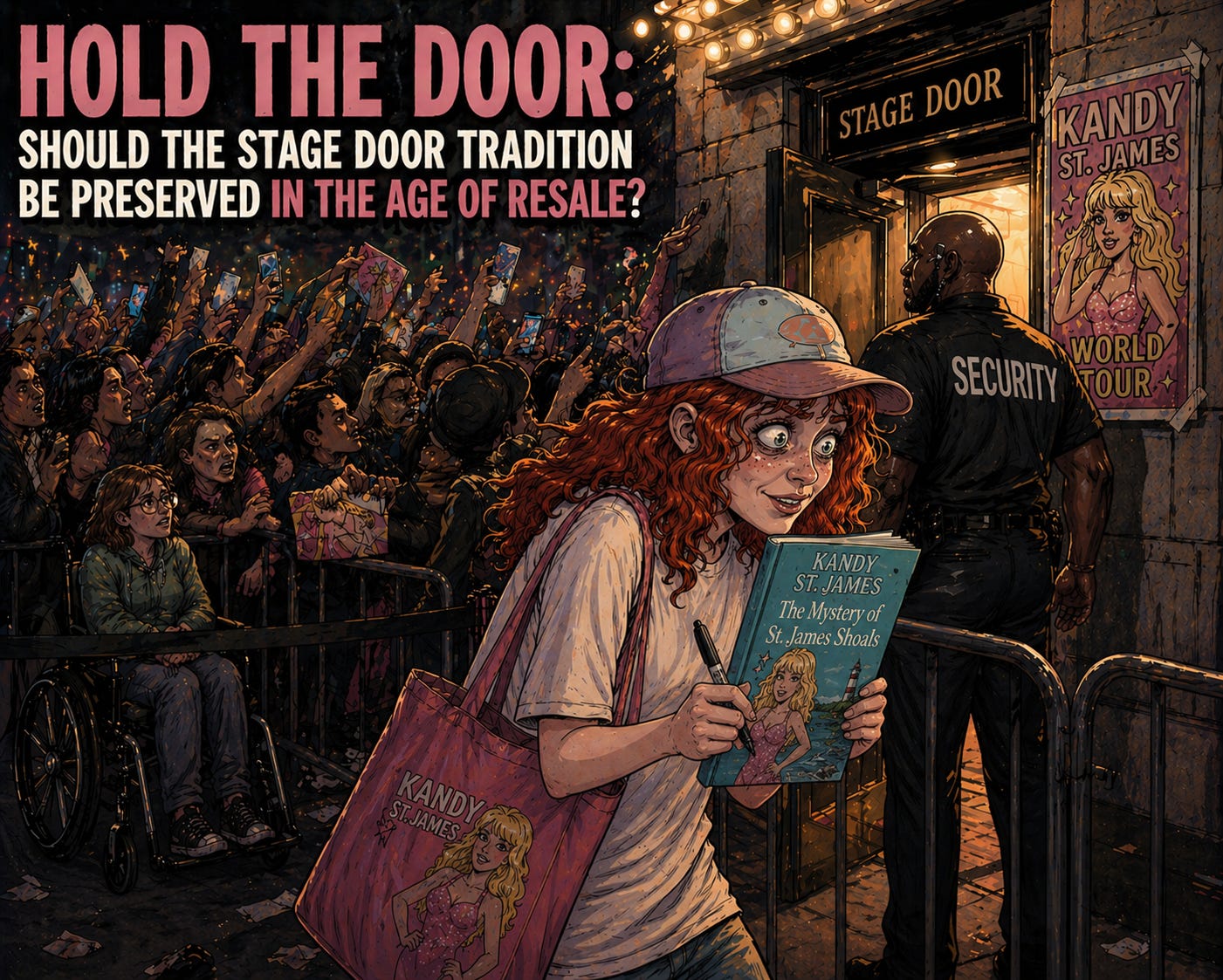
I’ve recently written about my work successfully securing access protocols for Disabled people at stage doors on Broadway and the West End. It’s important. As I’ve discussed, wheelchair users, little people, autistic people with high support needs, people with PTSD, blind people, and others are incredibly vulnerable at these unticketed experiences. Confusion, swinging bags and elbows, and overenthusiasm by fans to secure autographs and photos aren’t just an inconvenience or annoyance. They put Disabled people and needed medical equipment at very serious risk. That’s why I’ve been grateful for the cooperation and collaboration of the theatre industry in this important work so far.
I’ve also interrogated some of the dark underbelly of motive. How far is too far regarding fandom in the first place? What does it mean for these highly activated crowds outside a theatre to expect, or demand, the presence of a performer after an exhausting live performance, and to see and to mistakenly view an unticketed stage door as the end stage of a parasocial transaction?
I want, now, to flesh out something even less pleasant but necessary to expose, which is the idea that in the age of rapid-fire social media scrolling, dropshipping, and the ugly flourishing of online resale, the stage door experience may be permanently polluted.
I have a cohesive worldview on compliance: when I see a very predictable safety risk, I document it carefully and issue notice, ideally to prevent catastrophe instead of logging it after the fact.
In the case of safety for both talent and Disabled theatre-goers, I have known lately that not all those attending unticketed stage doors actually attended the performance in question. Why does this matter? If a theatre is located in a very small regional city, it probably doesn’t matter as much. In massive markets like New York and London, and particularly with viral shows or cast members whose careers are drawing significant attention elsewhere (of note in this era of so-called “stunt casting”), theatres may well experience massive swarms outside their stage doors night after night.
As is often the case with social media platforms like TikTok, X, and Instagram, attention builds cumulatively and algorithmically. The crowd grows. FOMO (“Fear of Missing Out”) sets in. The stage door of the show becomes “the place to be,” or, perhaps more alarmingly, a place that must not be missed, no matter what.
If those gathering in this very predictable stage door swarm were in a well-controlled crowd, with proper barriers, adequate security measures, reasonable non-competitive behavior, and consistent in person and online behavior not setting off alarm bells, then all of this would be perfectly fine.
That isn’t the case.
Instead, one glance around TikTok, X, and Instagram joined with some of the most popular shows or stars currently on Broadway and the West End reveals many accounts dedicated solely to the shows and performers, often proudly showcasing dedicated efforts to meet cast members in person even if not attending the shows, or to “add autographs to personal collections,” or gushing about how “sweet and nice” the individual’s “favorite” was, or breathlessly hoping to “get close.”
Then, nefariously, there are the resellers.
Theatre, of course, is not their only purview. Indeed, one need only head to a local Five Below discount store to witness the sociological absurdity of the “Limit 5 Glitter Dumplings Per Customer” phenomenon as profiteering grown women live-streaming their “hauls” of slime-filled balloons feud with actual children for the toys, which they then take to their SUVs for “unboxing videos.”
Resellers at Walt Disney World have been filmed stampeding into The Magic Kingdom at open, careening through the park, knocking over strollers, and filling up numerous bags with merchandise, which they then sell at enormous mark-ups on eBay and similar websites.
No, I am not making any of this up.
And similar phenomena are observed at stage doors, where individuals who certainly did not attend the show and have no artistic interest in the play or musical are present with one singular focus: profit.
These people do not care about the hard work put into the performance by talent or their fatigue. They do not care about well-intentioned and reasonable fans. They do not care about Disabled individuals in vulnerable bodies with expensive, necessary medical equipment.
Move, they seem to say. You are in the way of my money.
Stage doors should not happen merely because they have always happened. Society shifts, circumstances change, and protocols must be updated accordingly. Stage doors should happen only where productions and theatres are prepared to make the environment fair, controlled, and safe, especially for talent and Disabled bodies. The goal is not to end a beloved theatre tradition, but to preserve it responsibly before preventable harm makes that impossible.